

Introduction to B2B Content Strategy
In today's competitive B2B landscape, a well-crafted content strategy is no longer optional—it's essential. B2B content strategy is the systematic approach to creating, distributing, and analyzing content that supports business goals while meeting the needs of your target audience. It's a roadmap that guides your content marketing efforts, ensuring that every piece of content serves a purpose in your overall marketing plan.
Unlike random content creation, a strategic approach ensures consistency, relevance, and effectiveness. It aligns content with your business objectives, target audience needs, and the buyer's journey, creating a cohesive experience that nurtures leads and builds trust with potential clients.

The key elements of content strategy: Discover, Learn, Create, Launch, and Grow
Why B2B Content Strategy Matters
The B2B buying process has transformed dramatically in recent years. Today's B2B buyers complete a significant portion of their research online before ever contacting a vendor. According to Gartner, B2B buyers spend only 17% of their time meeting with potential suppliers when considering a purchase. This emphasizes the critical importance of having quality content readily available to influence decision-makers during their independent research phase.
A well-executed content strategy delivers several key benefits:
- Builds authority and credibility in your industry
- Generates qualified leads by addressing specific pain points
- Shortens sales cycles by proactively answering buyer questions
- Improves customer retention through ongoing value delivery
- Creates scalable marketing assets that continue to perform
- Provides competitive differentiation in crowded markets
Key Aspects of B2B Content Strategy
A successful B2B content strategy encompasses several crucial elements that work together to drive results. Understanding these components and their importance helps create a cohesive approach that delivers on business objectives:
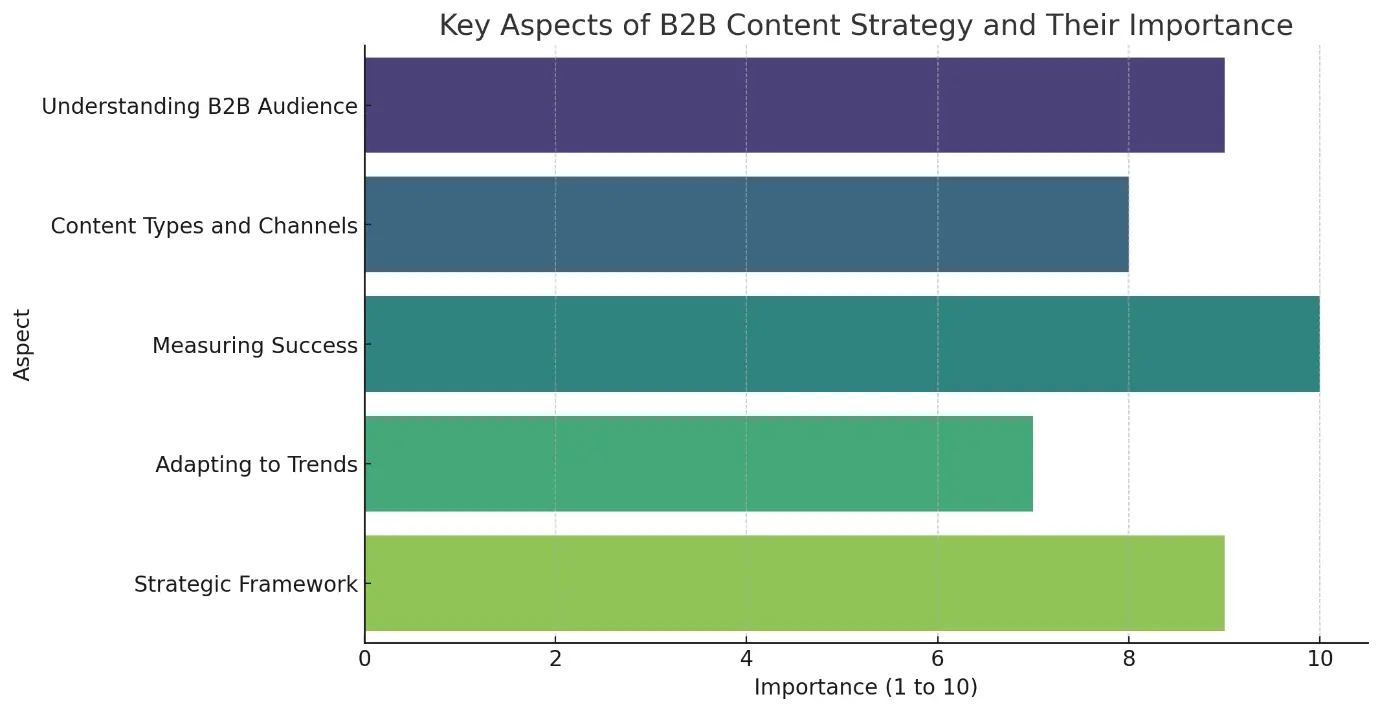
Importance rating of key aspects in B2B content strategy implementation
1. Understanding Your B2B Audience
The foundation of any effective content strategy is a deep understanding of your target audience. This goes beyond basic demographics to include:
- Buyer personas: Detailed profiles of your ideal customers, including job roles, responsibilities, pain points, and goals
- Decision-making units (DMUs): Mapping the various stakeholders involved in B2B purchase decisions
- Industry-specific challenges: Understanding the unique problems faced in different sectors
- Information needs across the buyer's journey: Identifying what content topics and formats are most relevant at each stage
B2B purchases typically involve multiple decision-makers with different priorities. Your content strategy must address the diverse concerns of the entire buying committee, from technical implementers to financial approvers to executive sponsors.
2. Strategic Content Framework
A strategic framework provides structure to your content efforts, ensuring alignment with business goals. This includes:
- Content pillars: Core themes that reflect your expertise and audience interests
- Content mapping: Aligning content pieces with specific stages of the buyer's journey
- Editorial calendar: Planning content creation and distribution timelines
- Content governance: Establishing standards, workflows, and roles for content creation
Your framework should be flexible enough to adapt to changing market conditions while maintaining consistency in messaging and quality. It serves as a blueprint that guides individual content decisions within the larger strategic context.
3. Content Types and Distribution Channels
B2B content comes in many forms, each serving different purposes and audience preferences:
- Long-form content: Whitepapers, research reports, e-books, and case studies that demonstrate expertise and provide in-depth analysis
- Short-form content: Blog posts, articles, social media updates, and newsletters that maintain regular engagement
- Visual content: Infographics, videos, webinars, and presentations that explain complex concepts
- Interactive content: Assessments, calculators, configurators, and interactive demos that engage prospects
Distribution channels must be selected based on where your audience seeks information:
- Owned channels: Your website, blog, resource center, and email lists
- Earned channels: Industry publications, media coverage, and organic social sharing
- Paid channels: Sponsored content, paid search, and display advertising
- Shared channels: Social media platforms, online communities, and industry forums
The right mix of content types and channels creates multiple touchpoints with potential customers throughout their buying journey.
4. Measuring Content Success
Effective measurement is crucial for optimizing your content strategy over time. Key metrics to track include:
- Engagement metrics: Page views, time on page, bounce rate, social shares, and comments
- Lead generation metrics: Conversions, form completions, and content downloads
- Sales impact: Content-influenced pipeline, content-attributed revenue, and sales cycle length
- SEO performance: Organic traffic, keyword rankings, and backlinks
- Content ROI: Cost per lead, customer acquisition cost, and lifetime value
Beyond quantitative metrics, qualitative feedback from sales teams and customers provides valuable insights into content effectiveness. Establish a regular cadence for reviewing content performance and making data-driven adjustments to your strategy.
5. Adapting to Trends and Technologies
The B2B content landscape continuously evolves with changing buyer behaviors and technological advancements. Stay ahead by:
- Embracing new formats: Podcasts, interactive experiences, and immersive content
- Leveraging AI and automation: For content personalization, optimization, and distribution
- Implementing account-based marketing (ABM): Creating targeted content for high-value accounts
- Adopting content experience platforms: To deliver personalized content journeys
While trends come and go, the fundamentals of providing valuable, relevant content to your audience remain constant. Evaluate new approaches based on their potential to better serve your specific business goals and audience needs.
Implementing Your B2B Content Strategy
Moving from strategy to execution requires a systematic approach:
1. Content Audit and Gap Analysis
Begin by assessing your existing content. Categorize each piece by topic, format, buyer stage, and performance. Identify gaps where you lack content for specific personas, stages, or topics. This analysis provides a baseline for your strategy and highlights immediate opportunities.
2. Content Production and Workflow
Establish clear processes for content creation:
- Develop detailed briefs that align each piece with strategic objectives
- Create style guides and templates for consistency
- Build a content team with the right mix of skills (writing, design, SEO, etc.)
- Implement approval workflows that maintain quality without creating bottlenecks
3. Content Optimization
Maximize the impact of your content through:
- SEO best practices: Keyword research, on-page optimization, and technical SEO
- User experience: Readability, navigation, and formatting for easy consumption
- Conversion optimization: Strategic calls-to-action and landing page design
- Content repurposing: Extending the value of existing content across multiple formats
4. Content Promotion and Distribution
Create a systematic approach to content distribution:
- Develop channel-specific promotion strategies
- Engage your entire organization in content sharing
- Implement lead nurture workflows that leverage content
- Collaborate with industry partners for extended reach
5. Measurement and Refinement
Implement a continuous improvement cycle:
- Establish dashboards for tracking key performance indicators
- Schedule regular content performance reviews
- Gather feedback from sales teams and customers
- Test and experiment with new approaches
- Update your strategy based on results and market changes
Common B2B Content Strategy Challenges and Solutions
Challenge 1: Creating Consistent, High-Quality Content
Solution: Develop a sustainable content creation system through a mix of in-house resources, freelancers, and agencies. Implement content templates, repurposing strategies, and an editorial calendar to maintain consistency without sacrificing quality.
Challenge 2: Demonstrating Content ROI
Solution: Establish clear attribution models that connect content engagement to pipeline generation and revenue. Focus reporting on business outcomes rather than vanity metrics, and regularly share success stories that illustrate content impact.
Challenge 3: Aligning Sales and Marketing
Solution: Involve sales teams in content planning to address actual customer questions. Create sales enablement materials that help reps leverage content effectively, and establish feedback loops for continuous improvement based on field insights.
Challenge 4: Content Differentiation
Solution: Develop a unique perspective or content niche based on your company's distinctive expertise and value proposition. Conduct original research, share proprietary insights, and focus on depth rather than breadth in your content topics.
Conclusion
A strategic approach to B2B content marketing is essential for building relationships, establishing authority, and driving business growth in today's digital landscape. By understanding your audience, creating a robust framework, selecting the right content mix, measuring performance, and adapting to trends, you can develop a content strategy that delivers significant competitive advantages.
Remember that content strategy is not a one-time exercise but an ongoing process of planning, execution, analysis, and refinement. The most successful B2B organizations view content as a strategic asset worthy of consistent investment and attention.
As you develop and implement your B2B content strategy, focus on creating genuine value for your audience at every touchpoint. When your content consistently helps potential customers solve problems, make better decisions, and achieve their business objectives, marketing success naturally follows.